

Why Most 360 Feedback
Programs Fail
(And How to Change Them to Drive Behavior Change)
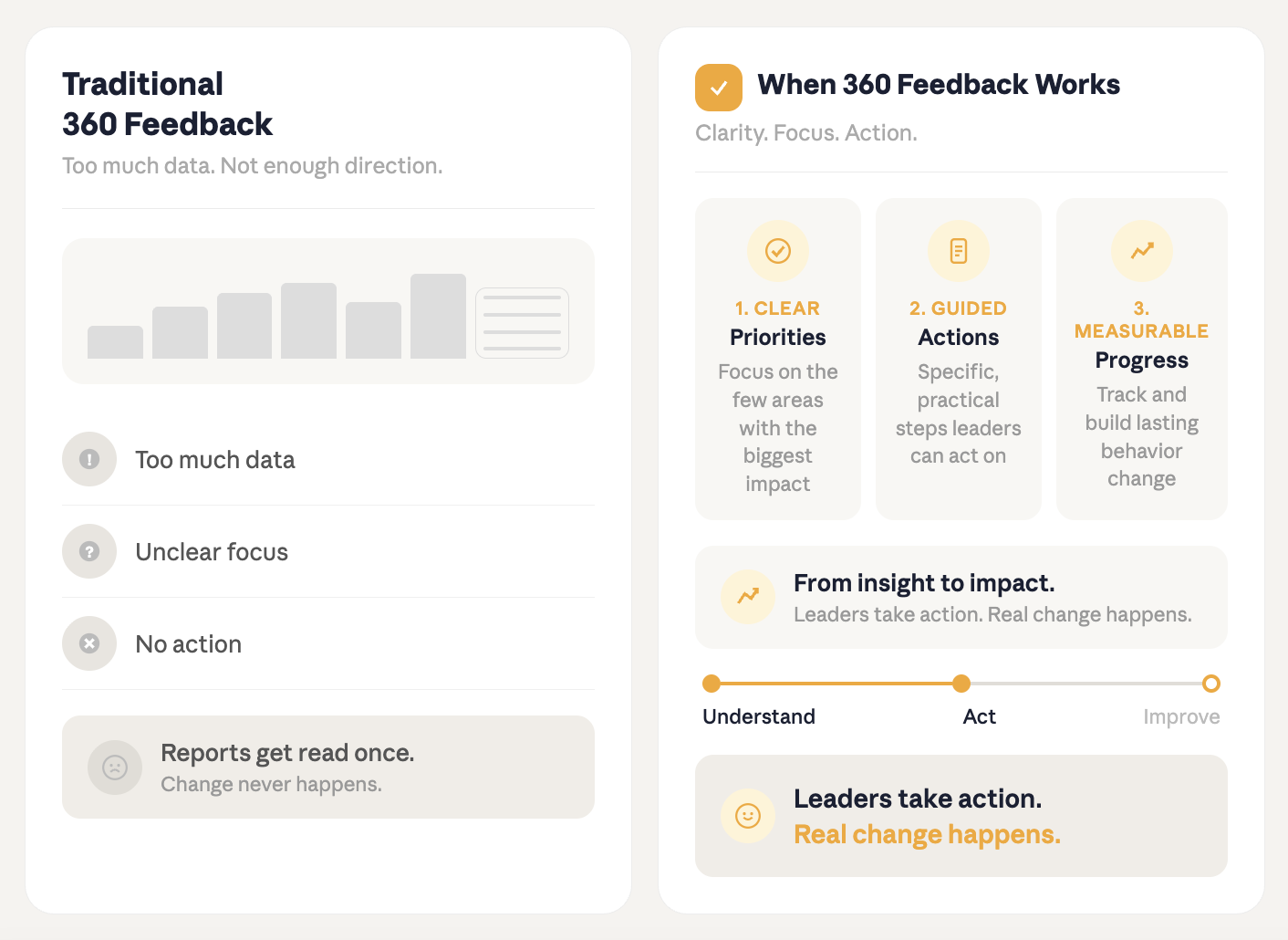
Most 360 feedback programs don’t fail loudly. They fail quietly—after leaders read the report… and nothing changes.
After working with thousands of organizations, a clear pattern emerges: most 360 feedback programs fail for the same reason. It's a design problem—not a people problem.
30+ years · 45 languages · 53 countriesTrusted by organizations worldwide to turn feedback into action• Public Sector
• Independent Consultancies
• Leadership Institutes
• Global Enterprises
• Fortune 50
• Government
• Fortune 500
• Corporate Universities
• Public Sector • Independent Consultancies • Leadership Institutes • Global Enterprises • Fortune 50 • Government • Fortune 500 • Corporate Universities
01 — The Core ProblemIt’s Not the Data.
It’s The Insight-to-Action Gap.
At first, a 360 feedback process feels like it's working.
Participation is strong. Reports are full of insight. Leaders engage.
But a few weeks later—very little has changed.
If that feels familiar, it's not a coincidence. Most organizations don’t realize their 360 program isn’t working—until leaders stop taking it seriously.
After working with thousands of organizations, a clear pattern emerges: most 360 feedback programs fail for the same reason.
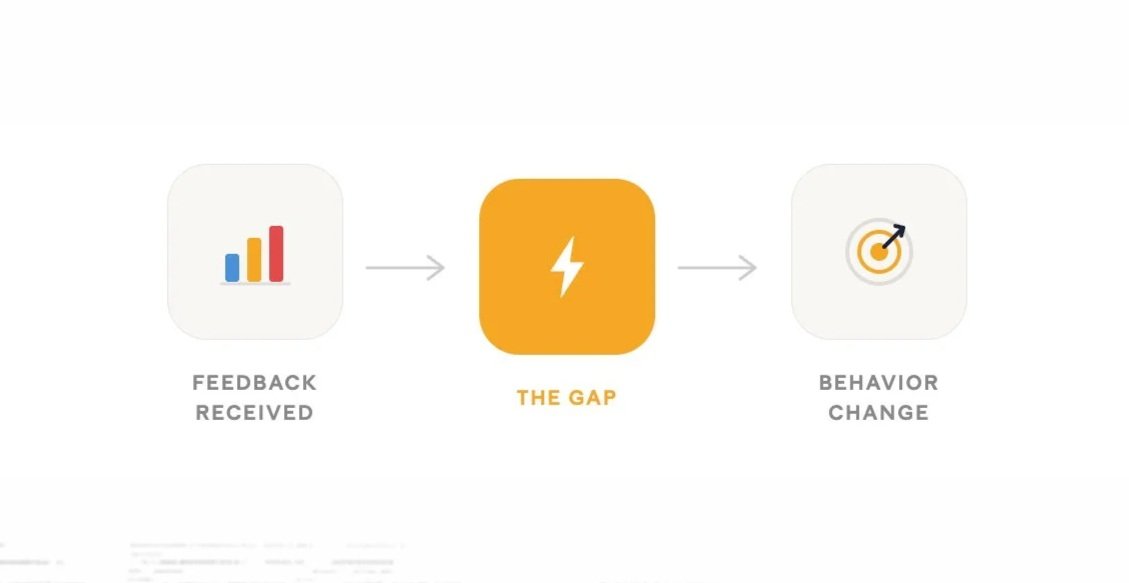
The Insight-to-Action Gap is the disconnect between receiving feedback and knowing how to turn it into meaningful improvement.
It's a design problem—not a people problem.
We call it the Insight-to-Action Gap.
In most 360 feedback programs, leaders gain awareness—but lack a clear, structured process to translate that insight into focused action and sustained behavior change.
As a result, feedback is understood but not applied.
Without action, improvement doesn’t happen.
The difference between 360 feedback that works and 360 feedback that fails is whether it closes the Insight-to-Action Gap.
02 — What Actually Works360 feedback is a structured process used to gather input about a leader from multiple perspectives—typically peers, direct reports, and managers. Refer to the Guru’s Guide to 360 Feedback to learn the mechanics.
But the purpose of 360 feedback isn’t to collect data.
It’s to drive improvement.
What is 360 feedback (and what actually works)?
01 Make results immediately clear
02 Help leaders identify what matters most
03 Guide the creation of a focused action plan
04 Build ownership of development
05 Support follow-through over time
When these elements are present, 360 feedback becomes a system for behavior change. When they’re missing, it becomes a reporting exercise—with little lasting impact.
03 — Signs It’s FailingSigns your 360 feedback process is failing
These are the most common signals that a 360 feedback process is not closing the Insight-to-Action Gap.
-

More Data Creates Less Clarity
Leaders scan pages of data and ask: “What should I actually focus on?” When everything looks important, nothing is. Without clear priorities, hesitation takes over—and hesitation stops progress.
-

Insights Don’t Lead to Action
Leaders understand their results—but don’t act on them. There is no mechanism that turns understanding into action. So the feedback is acknowledged—but not applied.
-

The Process Depends on Debriefs
After the facilitator leaves, leaders are left asking: Do I really understand this well enough? Am I focusing on the right thing? What do I do if this doesn’t work? The process becomes dependent on facilitation instead of being self-sustaining.
-

Leaders Don’t Take Ownership
Plans feel generic. Priorities feel unclear. Next steps feel optional. So instead of driving change, leaders wait—for direction, for follow-up, for momentum. Without ownership, development becomes inconsistent.
-

Participation Is Low or Cautious
Low participation—or overly safe feedback—is a signal of a deeper issue. In some cases, it’s trust. In other cases, it’s friction: the process feels too long, complex, or time-consuming. The result is the same: lower-quality data and lower confidence in the outcome.
-

Difficult to Sustain at Scale
What works for a small group breaks down as the program grows. More participants create more coordination. More debriefs create more dependency. More follow-up creates more administrative burden. The system wasn’t designed to scale efficiently.
Recognize any of these in your program?
Let’s show you what closing the gap actually looks like.
04 — Root CauseHidden assumptions in traditional 360 systems
Most 360 feedback programs are built on assumptions that quietly undermine results.
-
Interpreting feedback and turning it into action is a skill most systems don’t teach.
-
If anonymity is even slightly in question, feedback becomes cautious and incomplete.
-
As programs grow, complexity increases, debriefs become bottlenecks, and consistency breaks down.
THE BOTTOM LINE
Organizations invest in 360 feedback to improve leadership capabilities, not just to gather and report feedback. It fails because the process doesn’t teach leaders how to turn insight into action—or support them as they follow through.
Fix the process—and everything changes.
05 — The Solution5 keys to closing the Insight-to-Action Gap
When 360 feedback actually works, five things change. The best 360 programs don’t focus on delivering more data—they focus on what leaders do next.
-
A simple, user-friendly experience from beginning to end
Participants should know what to do. Raters should complete surveys quickly. Leaders should engage with results without confusion. When the process is clear
- Participation increases- Trust improves
- Momentum is maintained
-
Results that are instantly clear (the 10-second rule)
Leaders should be able to open their report and immediately understand what matters. If they have to study charts, decode scales, or search for meaning, the system is working against them.
- If you can’t understand a page in 10 seconds, it’s too complex
- Clarity creates confidence
- Confidence leads to action
-
Action planning that is built in—not tacked on
In many systems, action planning is confined to the last page. By then, attention has dropped and momentum is gone. In a better-designed system action is introduced early, reinforced throughout, and completed as part of the experience.
- Action introduced early- Reinforced throughout
- Leaders leave with a plan
-
Guided discovery instead of prescriptive recommendations
Generic recommendations often create resistance. Leaders may feel the advice doesn’t fit their situation—and disengage. A more effective approach is guided discovery.
-Interpret their results- Identify priorities
- Build their own plan
-
A built-in way to sustain change over time
Insight fades quickly without reinforcement. Leaders need a simple way to involve their manager, share focus areas, and stay accountable over time—not through complex systems, but through clear, repeatable steps.
- Involve their manager- Share focus areas
- Stay accountable over time
Free 30-minute walkthrough — no commitment
06 — Product ShowcaseOne purpose. Eliminating the Insight-to-Action Gap.
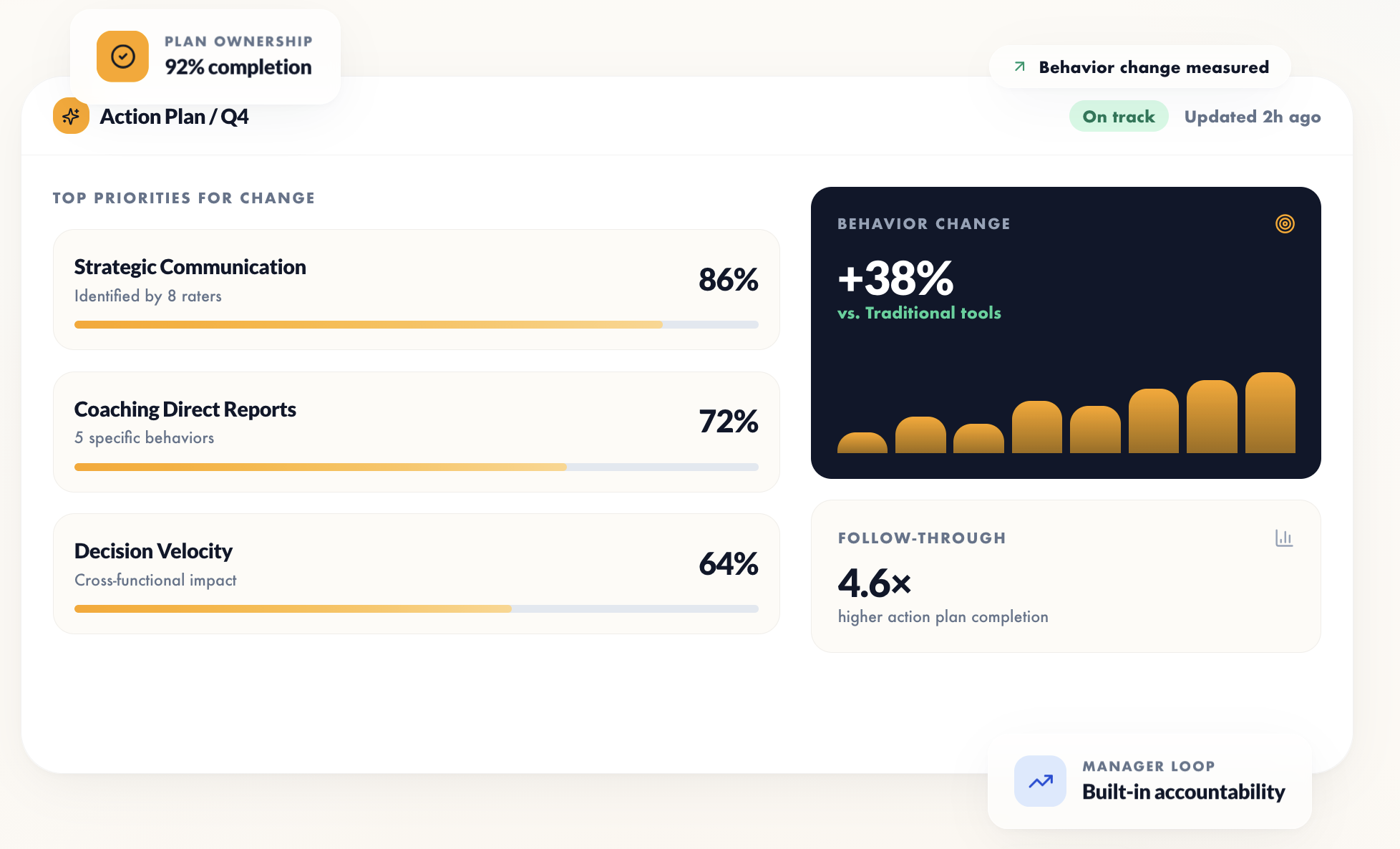
We don’t see 360 feedback as a reporting tool. STAR360feedback is built specifically to drive behavior change—not just deliver insight.
-
Reports immediately understood
No decoding scales or studying charts.
-
Action planning </br>built in
Not added at the end of the experience.
-
Ownership over dependency
Leaders own their plan and follow-through.
-
Scales without complexity
No added admin or facilitation overhead.
07 — Vendor CategoriesTypes of 360 feedback vendors (and when to choose each)
Not all 360 feedback vendors are designed for the same outcome. Most fall into one of three categories.
-

01 / Data-Heavy
Data-Heavy 360 Feedback Platforms
Designed to collect large amounts of feedback and present detailed reports. Used in organizations that prioritize analytics and benchmarking, want deep data across many competencies, and prefer proprietary models tightly controlled by vendors.Effective for analysis—but built to deliver data and reinforce models, not drive behavior change. They consistently fail to produce long-term improvement.
-

02 / Facilitator-Driven
Facilitator-Driven 360 Solutions
Rely heavily on coaches or debriefers to interpret results and guide development. Used when organizations want a guided, high-touch experience, internal capability for debriefing is limited, and development is driven through coaching conversations.
Strong short-term results—but often create dependency on facilitators, limit scalability, and momentum fades once the facilitators are gone.
-

03 / Action-Focused
Action-Focused 360 Systems
Designed specifically to help leaders turn feedback into behavior change. Focus on clear, easy-to-understand insights, integrated action planning, building ownership of development, and sustaining change over time.
STAR360feedback is part of this category—designed to eliminate the Insight-to-Action Gap completely, ensuring feedback leads to action, ownership and measurable improvement.
08 — Side by SideCompare STAR360feedback with traditional tools
For organizations using 360 feedback to drive leadership development, the most important differences are not in the survey and reporting process—they are in clarity, ownership, follow-through, and the ability to scale without dependency on facilitators.
| Dimension | Traditional 360 Tools | STAR360feedback ACTION-FOCUSED |
|---|---|---|
| User Experience | ✕ Multi-step, often complex | ✓ Simple, intuitive from start to finish |
| Clarity of Results | ✕ Data-heavy, requires interpretation | ✓ Clear priorities visible within seconds |
| Action Planning | ✕ Added at the end of the report | ✓ Integrated throughout the experience |
| Approach to Guidance | ✕ Prescriptive, generic recommendations | ✓ Guided discovery that builds ownership |
| Follow-Through | ✕ Depends on facilitator or individual effort | ✓ Built-in structure to support sustained change |
| Scalability | ✕ Requires increasing admin and facilitation | ✓ Designed to scale without added complexity |
| Participant Trust | ✕ Often dependent on communication | ✓ Built into the design (anonymity + simplicity) |
09 — CredibilityThree decades of designing for behavior change.
STAR360feedback has supported millions of 360 feedback surveys across 45 languages and 53 countries. Our work spans Fortune 50 organizations, government entities, corporate universities, and independent consultancies—and we’ve contributed to the development of tools used by institutions such as Harvard.
-
30+
Years of experience refining behavior-change design
-
Millions
of 360 surveys delivered across global programs
-
45
Languages
Truly global leadership development -
53
Countries
Public and private sector reach
STAR360feedback is best suited for organizations that want a 360 feedback system that drives behavior change—not just delivers insight. It’s a strong fit when you need a solution that helps leaders act on feedback, delivers clear results within seconds, integrates action planning throughout, builds ownership instead of dependency, and scales without administrative burden.

THE BOTTOM LINEIf your 360 isn’t driving change, it’s not a feedback problem.
It’s a process problem. Fix the process—and everything changes.
See how to eliminate the Insight-to-Action Gap and turn feedback into measurable improvement.
Frequently Asked Questions
-
360 feedback is a structured process used to gather perceptions of a leader from multiple perspectives—typically peers, direct reports, managers, and sometimes customers.
The goal is not just to evaluate performance, but to help leaders understand how their behavior impacts others so they can improve.
But the value of 360 feedback doesn’t come from collecting input.
It comes from what happens after the feedback is received.
-
Most 360 feedback programs fail because they focus on reporting data instead of guiding action.
The data is often accurate. The patterns are meaningful. The opportunities are real.
But without a clear process that helps leaders:
prioritize what matters
translate insight into behavior
and follow through over time
the feedback never turns into meaningful change. Organizations invest in 360 feedback to improve skills, not just collect and report data.
-
Yes—but only when they are designed to drive behavior change.
When a 360 process focuses primarily on collecting and presenting data, the impact is limited.
When it is designed to:
simplify what matters
guide leaders step-by-step
and create ownership of development
it becomes one of the most effective tools for leadership growth.
The difference isn’t the survey.
It’s the design of the process around it.
-
Honest feedback depends on trust—and trust depends on how anonymity is designed.
If participants believe their responses could be traced back to them, even slightly, they will adjust their feedback.
They may:
soften their language
avoid sensitive topics
or hold back critical insights
A well-designed 360 process ensures:
responses are grouped and never identifiable
comments are blended and de-personalized
no metadata can reveal identity
When people trust the process, they give feedback that is far more useful—and far more actionable.
-
The Insight-to-Action Gap is the disconnect between receiving feedback and knowing how to use it effectively.
In many 360 feedback programs, leaders gain awareness—but lack a clear, structured process to translate that awareness into meaningful change.
Closing this gap is what determines whether a 360 program creates real improvement—or becomes a one-time reporting exercise.
-
A good 360 feedback tool doesn’t just deliver data—it helps leaders change.
The most effective tools:
make insights clear and easy to understand
highlight what matters most
guide leaders in building an action plan
create a sense of ownership
and support follow-through over time
If a tool requires extensive interpretation, external facilitation, or heavy administrative effort to be effective, it’s not designed for sustained impact.
-
When evaluating a 360 feedback vendor, the most important question is:
Does this process help leaders act on feedback—or just understand it?
Look for a solution that:
prioritizes clarity over complexity
integrates action planning throughout the process
builds trust through strong anonymity design
scales without increasing administrative burden
and enables leaders to take ownership of their development
The right vendor doesn’t just provide feedback.
They provide a system that turns feedback into results.
-
Choosing the best 360 feedback vendor isn’t about features—it’s about outcomes.
Most vendors can help you collect feedback and generate reports.
Far fewer are designed to help leaders act on that feedback and improve over time.
When evaluating 360 feedback providers, focus on five critical factors:
1. Clarity of Results
Leaders should be able to understand what matters within seconds. If reports are complex or require heavy interpretation, action is unlikely to follow.
2. Built-In Action Planning
In many systems, action planning is added at the end. The most effective vendors integrate action planning throughout the experience so leaders leave with a clear, usable plan.
3. Ownership vs. Dependency
Avoid systems that rely heavily on facilitators to make the process work. The best solutions help leaders interpret their feedback and take ownership of their development.
4. Simplicity of the Process
A user-friendly experience increases participation, improves trust, and keeps momentum high. Complex systems reduce engagement and slow progress.
5. Ability to Scale
Many 360 feedback programs work at small scale but become difficult to manage as they grow. Look for a vendor that can scale without increasing administrative effort or cost.
Ultimately, the best 360 feedback vendor is the one that doesn’t just deliver insight—but consistently turns feedback into action, ownership, and measurable improvement.
-
Debriefs can be valuable—but they shouldn’t be required for the process to work.
In many traditional systems, the effectiveness of the 360 depends heavily on the quality of the facilitator.
This creates challenges:
limited scalability
inconsistent experiences
and ongoing dependency
A well-designed 360 process should guide leaders clearly enough that they can understand and act on their feedback—even without a facilitator.
Debriefs should enhance the process—not make it functional.
-
Leaders act on feedback when three things are present:
Clarity – They know what matters most
Structure – They know what to do next
Ownership – They feel responsible for following through
Without these, even the best feedback will sit unused.
When a 360 process is designed to create all three, action becomes the natural outcome—not something leaders have to be pushed into.
-
It can—but it often shouldn’t be.
When 360 feedback is tied to performance evaluation:
participants may be less honest
feedback becomes more cautious
and development value decreases
Most effective organizations use 360 feedback primarily for development, where the goal is improvement—not judgment.
This creates more openness, more trust, and ultimately more meaningful change.
Still have questions?
We’ll show you how STAR360 fits your program.